
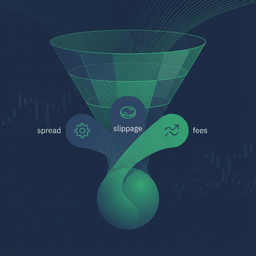
All In Cost: Spread, Slippage, and Fees in One Number
What all in cost means
All in cost is the total trading friction you pay to enter or exit a position. It combines:
• execution cost (spread, slippage, impact)
• platform fees
All in cost is what decides whether your expected edge is real or only theoretical.
Why all in cost beats isolated metrics
Looking at only spread is misleading. Looking at only fees is also misleading. What matters is the combined effect on your realized returns.
A market with low fees but wide spreads can be worse than a market with higher fees but tight execution.
Execution cost: measure it with effective spread
The best practical measure of realized execution cost is effective spread.
ES = 2 × |Pexec - M|
• Pexec is your execution price (use VWAP for multiple fills).
• M is the midquote at the time of the trade.
Fees: what to include
Include the fees you actually pay per trade. Common fee types:
• taker fees (paying for immediate liquidity)
• maker fees or rebates (for resting liquidity)
• exchange fees per contract or percent
• any settlement or transaction fee that is charged on fills
If your platform has a maker taker model, log whether you were maker or taker for each trade.
All in cost formula (one way)
A simple usable definition for one side of a trade:
All in cost (one way) = effective spread + fees (one way)
For a full in and out:
All in cost (round trip) = entry all in cost + exit all in cost
This is the number you compare to your expected edge.
Worked example
Suppose you enter a position:
• best bid 48c, best ask 52c, midquote 50c
• you buy and your VWAP is 52.4c
• effective spread = 2 × |52.4 - 50| = 4.8c
Now include fees:
• fee is 0.7c per contract one way
• one way all in cost = 4.8c + 0.7c = 5.5c
If you plan to exit later with similar costs, round trip all in cost could be around 11c.
This is why many strategies that look profitable on paper fail in thin prediction markets.
How to use all in cost in decision making
Pre trade filter
Before trading, estimate your likely cost:
• use quoted spread and visible depth as a rough proxy
• add expected fees
If estimated cost exceeds your edge, skip the market.
Post trade measurement
After trading, measure realized cost:
• compute VWAP from fills
• capture the aligned midquote snapshot
• compute effective spread
• add realized fees
Track this by market and by time. It becomes your execution quality dashboard.
Common mistakes
Only measuring entry: exit costs often dominate.
Mixing units: cents and decimals must not be mixed.
Using last trade price: use midquote, not last price.
Ignoring missed fills: limit orders that do not fill have an opportunity cost.
Takeaway
If you use one metric to judge whether a prediction market strategy is viable, use all in cost. It forces you to face the real question: after spreads, slippage, impact, and fees, do you still have edge.
Related
• Effective Spread vs Quoted Spread: What's the Difference
• How to Compute VWAP from Multiple Fills